Keeping urgent maintenance messages useful
An EV motor testbed produces routine diagnostics alongside maintenance alerts and fault reports. Those messages have different urgency, yet they compete for communication resources. My work connected the testbed to the ICPS Lab and examined how differentiated 5G treatment could protect the messages that matter most during congestion.
My contribution
At Solutions Serafin, I designed and implemented connectivity for MQTT-based telemetry exchange and analysis between the motor testbed and the lab. I collaborated with R&D, IT, maintenance engineers, and technicians on experiments and communication requirements. The telemetry supported analysis of signals including current, voltage, torque, RPM, vibration, and temperature.
I also developed a QoS-aware framework in ns-3/5G-LENA and compared best-effort and slice-aware configurations under controlled background load. This research formed part of my M.A.Sc. thesis and the journal article coauthored with Soumaya Yacout.
Connecting application needs to network behavior
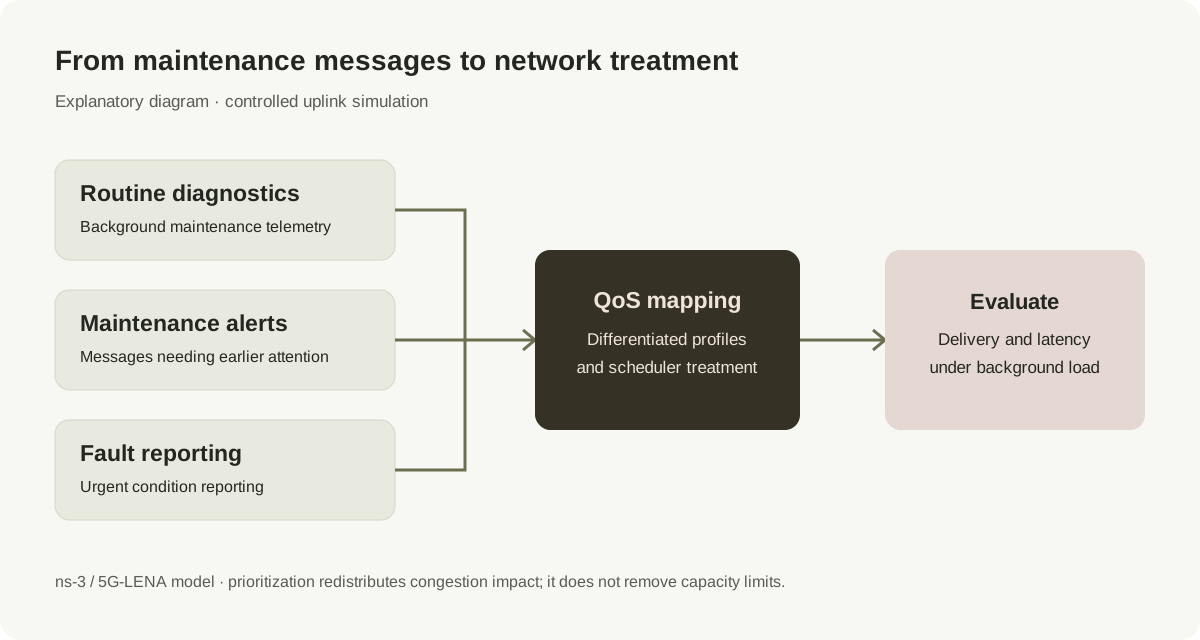
The simulation mapped three maintenance traffic classes—routine diagnostics, maintenance alerts, and fault reporting—to differentiated QoS treatment. Message urgency gave the prioritization a concrete purpose.
I evaluated delivery reliability alongside the latency of delivered packets. Reading those measures together matters: low latency among the packets that survive can conceal a high loss rate.
The testbed integration and the simulation answer different questions. The first establishes a telemetry path; the second tests communication policies under repeatable modeled conditions.
What the work showed
Prioritizing maintenance alerts and fault reports improved their delivery reliability during congestion in the evaluated model. Routine diagnostics could receive less favorable service as resources became scarce, making the tradeoff between traffic classes visible.
The resulting framework connects maintenance requirements to network treatment and provides a controlled way to examine that tradeoff. The research was published in the Journal of Quality in Maintenance Engineering on September 1, 2026.
Study conditions
The simulation evaluates uplink communication with one UE, one cell, fixed radio conditions, and abstracted core behavior. Its results describe communication performance within that setup. The published article documents the research; employer telemetry and internal testbed details remain private.
A closer look